
About Refrigerant R454B
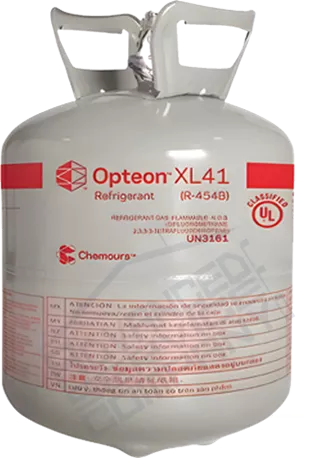
The transition to R-454B refrigerant marks a major change in the residential and light commercial HVAC industry as manufacturers move toward lower-global-warming-potential (GWP) alternatives. For many years, air-conditioning systems commonly used R-410A, which provided strong performance but has a relatively high GWP. As environmental concerns and regulations have intensified, the industry has sought refrigerants that maintain efficiency while significantly reducing climate impact. R-454B has emerged as a leading replacement because it offers similar operating characteristics while cutting GWP by roughly 75 percent compared to R-410A.
Government policies and international agreements have been key drivers behind this transition. The Kigali Amendment to the Montreal Protocol established a global framework to reduce the use of high-GWP hydrofluorocarbons (HFCs), while in the United States the American Innovation and Manufacturing (AIM) Act mandates a gradual phasedown of HFC production and consumption. To meet these requirements, HVAC manufacturers have developed new systems specifically designed for refrigerants like R-454B that comply with environmental standards while still providing reliable cooling performance.
R-454B is classified as an A2L refrigerant, meaning it has low toxicity and mild flammability. Because of this classification, new safety standards and equipment designs have been introduced to ensure safe installation and operation. Organizations such as ASHRAE and Underwriters Laboratories have updated codes and testing standards that address charge limits, airflow requirements, and system safeguards. HVAC equipment manufacturers have also redesigned compressors, coils, and electronic controls so that new air-conditioning systems can operate safely and efficiently with R-454B.
The shift to R-454B also affects technicians and the broader HVAC supply chain. Contractors must become familiar with new service procedures, safety protocols, and labeling requirements associated with mildly flammable refrigerants. Training programs are increasingly focusing on proper handling, leak detection, and installation practices for A2L systems. While the transition requires adjustments across the industry, the adoption of R-454B represents an important step toward lowering the environmental impact of cooling technologies while maintaining high levels of performance and reliability.
R454B Characteristics
R454B is an efficient refrigerant.
R454B uses POE oil unlike mineral oil requirements of the
refrigerant R22.
R454B is a zeotropic blend, consisting of 68.9%
difluoromethane (R-32) and 31.1% 2,3,3,3-tetrafluoropropene (R-1234yf).
R454B contains no chlorine and its ozone depletion
potential (ODP) is zero.
R454B if classified as a HFC/HFO refrigerant.
R454B has a safety classification of A2L, which means
mildly flammable and low toxicity.
R454B is a safe refrigerant when used with the proper
refrigerant mitigation systems.