
About Geothermal
One of the biggest advantages of geothermal HVAC systems is their energy efficiency and environmental benefits. These systems can reduce energy consumption significantly compared to conventional furnaces and air conditioners. Since geothermal systems rely on renewable energy stored in the ground, they produce fewer greenhouse gas emissions and can lower utility costs for homeowners and businesses. Additionally, geothermal systems often have longer lifespans than traditional HVAC equipment, making them a long-term investment in both comfort and sustainability.
Proper installation and system design are critical to the performance of geothermal systems. This is where Advanced Service Company LLC can play an important role. Their HVAC professionals can evaluate a property, determine the best type of ground loop system, and ensure the geothermal unit is installed correctly. With the right expertise and equipment, they can design a system that maximizes energy efficiency while providing consistent heating and cooling throughout the building.
In addition to installation, Advanced Service Company LLC can also provide maintenance and service for geothermal HVAC systems. Routine maintenance such as checking loop pressure, inspecting heat pump components, and ensuring proper airflow helps keep the system operating efficiently. If issues arise, trained technicians can diagnose and repair the system to restore performance quickly. With professional installation and ongoing service, geothermal HVAC systems can deliver dependable comfort and energy savings for many years.
Components of a Geothermal System
Indoor Coil
The coil that usually functions as an evaporator in a normal air-conditioning unit.
Outdoor Coil
The coil that usually functions as a condenser in a normal air-conditioning unit.
Reversing Valve
The valve that directs the flow of refrigerant to the appropriate coil based on which mode the heat pump is in, Heating or Cooling.
High-density polyethylene (HDPE) pipe
Special lines that are installed in ponds or the earth to absorb the warmth or coldness of the medium it is located in.
Compressor
The component that pumps the refrigerant throught the system.
Indoor Fan Motor
The Fan Motor that circulates air through the indoor coil and supply side of the duct system.
Outdoor Fan Motor
The Fan Motor that pulls air through the outdoor coil to cool the refrigerant or condense the refrigerant and remove heat from the refrigerant.
Bi-directional Expansion Valve
A metering device that is capable of metering refrigerant or bypassing the metering section depending on the direction the refrigerant is flowing.
Check-Valve
Restricts or allows flow of refrigerant depending on which way the refrigerant is flowing.
Water Pump
An electric motor that pumps water (and antifreeze) through the plumbing system of the geothermal unit.
Antifreeze or Brine
The fluid that is added to water that circulates through the geothermal units plumbing system to keep the water from freezing.
Efficiency of a Geothermal System
ENERGY STAR
ENERGY STAR - Products/Homes/Buildings that earn the ENERGY STAR prevent greenhouse gas emissions by meeting strict energy efficiency guidelines set by the U.S. Environmental Protection Agency and the U.S. Department of Energy. To learn more, please visit www.energystar.gov.
EER
EER - The EER is the efficiency rating for the equipment at a particular pair of external and internal temperatures. SEER rating more accurately reflects overall system efficiency on a seasonal basis and EER reflects the system’s energy efficiency at peak day operations.
EER2
EER2 - The EER2 is the efficiency rating for the equipment at a particular pair of external and internal temperatures. SEER2 rating more accurately reflects overall system efficiency on a seasonal basis and EER2 reflects the system’s energy efficiency at peak day operations. EER2 measures the energy efficiency of an air conditioner or heat pump at the outdoor cooling temperature of 95°F.
SEER
SEER - This is a measurement of the efficiency of cooling products. The higher the SEER, the more efficient the cooling product. SEER stands for Seasonal Energy Efficiency Rating.
SEER2
SEER2 - This is a measurement of the efficiency of cooling products. This is the most recent standard for measurement of the efficiency of cooling products. The new standard implements a stricter airflow requirement of .5 IWC versus the original .1 IWC. SEER2 stands for Seasonal Energy Efficiency Rating 2.
HSPF
HSPF - This is a measurement of a heat pump's heating efficiency. The higher the HSPF, the more efficient the heat pump's heating performance. HSPF stands for Heating Seasonal Performance Factor.
HSPF2
HSPF2 - This is a measurement of a heat pump's heating efficiency. This is the most recent standard for measurement of the efficiency of heating products. The new standard implements a stricter airflow requirement of .5 IWC versus the original .1 IWC. The higher the HSPF2, the more efficient the heat pump's heating performance. HSPF2 stands for Heating Seasonal Performance Factor 2.
COP
COP - Coefficient Of Performance. A ratio that compares a heat pump system's heating efficiency to that of electric resistance heat. For example, a heat pump system with a COP of 3.0 provides heat at 3 times the efficiency of electric resistance heat. A heat pump's system COP will decrease as outdoor temperatures drop, eventually providing little or no efficiency advantage over electric resistance heat - and that's when your auxiliary heat strips start to heat your home.
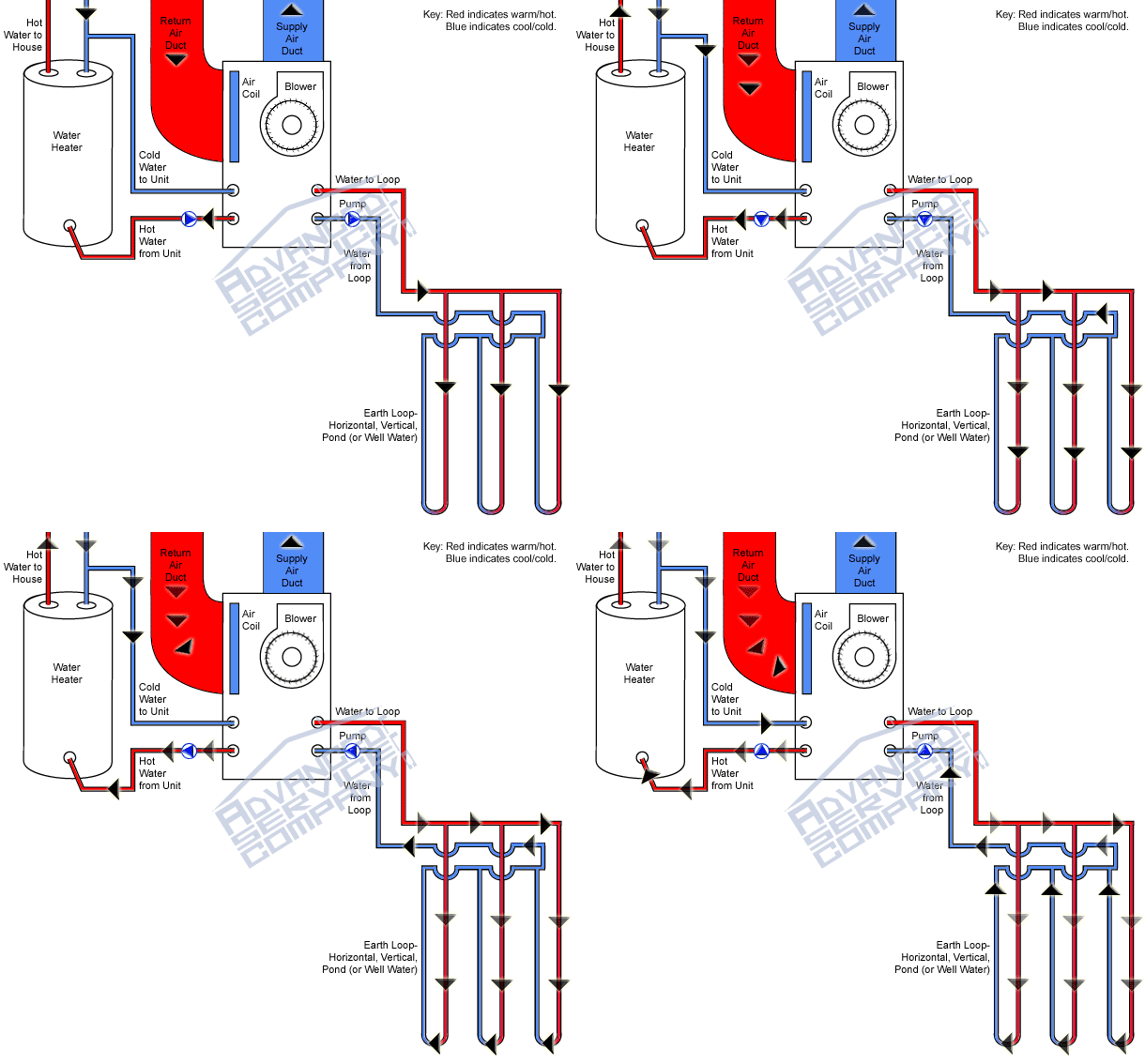
Operation of a Geothermal System in Cooling Mode
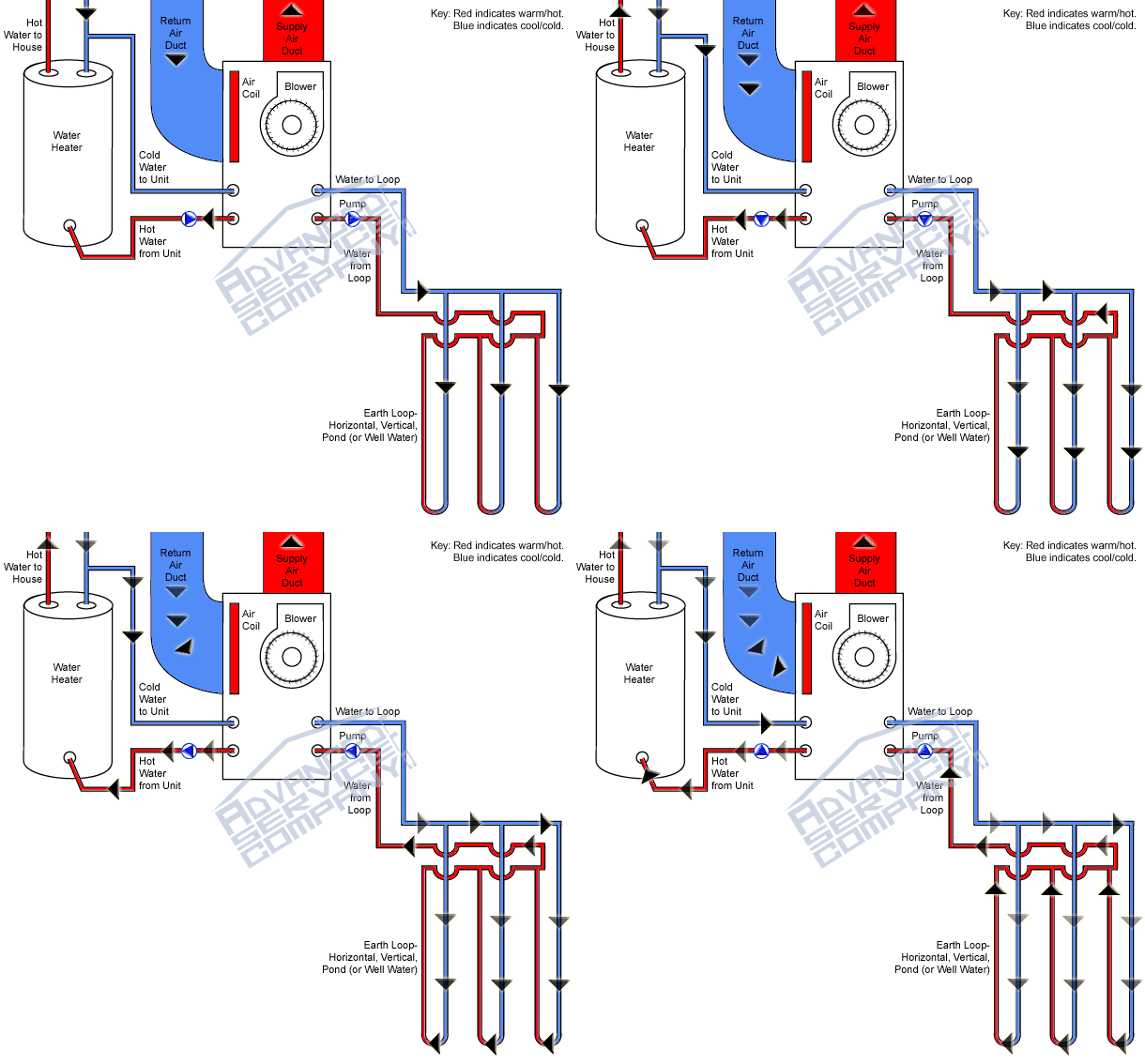
Operation of a Geothermal System in Heating Mode
Geothermal Loops
The following are pictures of different style loops:
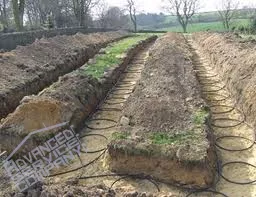
Geothermal Horizontal Loop
A horizontal loop field installation usually occurs in more rural areas or yards with lots of space. A horizontal loop field installation requires a great deal of land because a backhoe is used to dig up long trenches which are only a few feet deep (but below the frost line) in order to lay the necessary amount of piping. In some cases horizontal loop fields can be less costly to install than vertical because there is no drilling. Horizontal systems can be installed using an excavator or other ground moving machine and can be installed in 1-2 days.
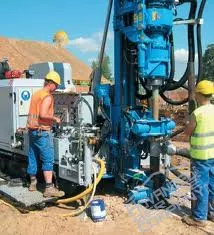
Geothermal Vertical Loop
A vertical loop field is the most common installation process for a geothermal heat pump that is installed on smaller properties. During a vertical loop field installation a series of holes are drilled, each between 50-400 feet deep. Then, piping is fed down these holes and connected in a loop pattern. Once all of the pipes are connected together outside of the home they are threaded into your home and attached to the heat pump unit. This process is often completed by a well driller in 1-2 days.
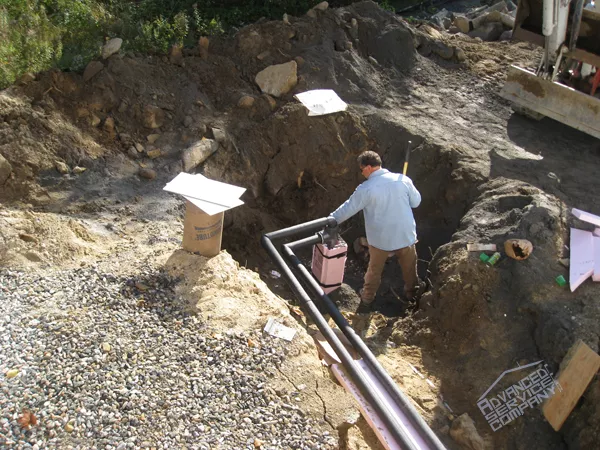
Geothermal Well Loop
An open loop is an earth loop that uses the water from a well to heat and cool your home. The water is pumped from the well through the geothermal heat pump's water-to-refrigerant heat exchanger coil and then returned to the earth. In the cooling season it rejects heat from your home into the water, and in the heating season it absorbs heat from the water into your home.
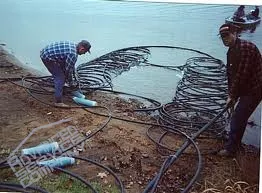
Geothermal Pond Loop
A pond loop field can be installed when the property is located near a large body of fresh water such as a pond or lake. Trenches, which measure only a few feet deep, are dug from the house to the body of water. These trenches are then filled with pipes which are connected to coils that are laid at the bottom of the lake or pond. These coils, often called slinkys, utilize the temperature at the base of the lake or pond to heat and cool the home just like a horizontal or vertical loop field. The image to the left is a slinky loop