
About A2L Refrigerants
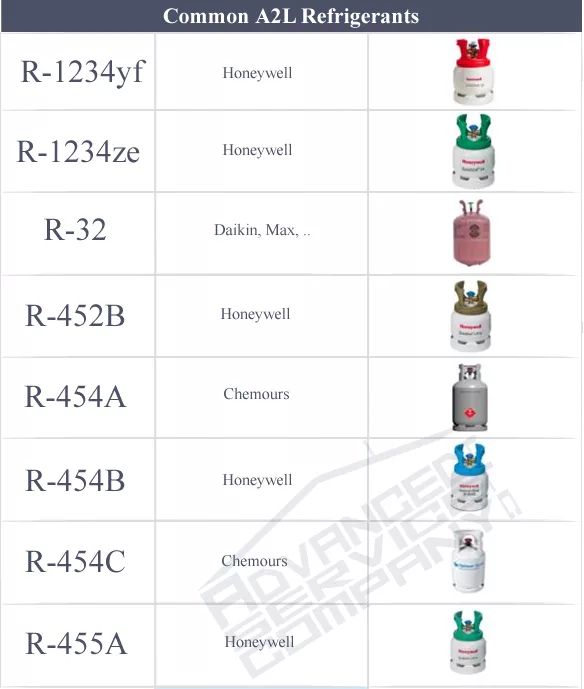
The transition to A2L refrigerants represents a major shift in the heating, ventilation, air conditioning, and refrigeration
(HVACR) industry as it responds to environmental regulations aimed at reducing greenhouse gas emissions. Traditional
refrigerants such as R-410A and R-134a have relatively high global warming potential (GWP), contributing significantly to
climate change if released into the atmosphere. In response, governments and international agreements are phasing down
high-GWP hydrofluorocarbons (HFCs). A2L refrigerants, which are classified as having lower toxicity and mild flammability,
have emerged as a key alternative because they offer much lower GWP while maintaining similar cooling performance.
The push toward A2L refrigerants is closely tied to policy measures such as the Kigali Amendment to the Montreal Protocol and
the U.S. American Innovation and Manufacturing (AIM) Act. These regulations require a gradual reduction in HFC production and
consumption, encouraging manufacturers to redesign equipment that can safely use lower-GWP options. Refrigerants such as R-32
and R-454B are among the leading A2L replacements for residential and commercial air-conditioning systems. Because A2L
refrigerants have much lower climate impact than many older HFCs, they help the HVACR sector align with global
emissions-reduction goals.
However, the mild flammability of A2L refrigerants requires updates to safety standards, building codes, and technician
training. Organizations such as ASHRAE and Underwriters Laboratories have developed new standards addressing system design,
ventilation, leak detection, and charge limits to ensure safe use. Equipment manufacturers have also redesigned compressors,
heat exchangers, and controls to accommodate the different thermodynamic properties and safety requirements of these
refrigerants. As a result, new systems are being engineered specifically for A2L compatibility rather than simply retrofitting
older equipment.
The transition also has important implications for the workforce and supply chain. HVAC technicians must receive updated
training to handle A2L refrigerants properly, including new installation procedures, leak-prevention techniques, and safety
practices. At the same time, distributors and contractors must adapt to new tools, labeling requirements, and refrigerant
management practices. Although the change requires investment and education across the industry, the adoption of A2L
refrigerants is widely seen as a necessary step toward reducing the environmental footprint of cooling technologies while
maintaining reliable and efficient climate control.
Manufacturer Refrigerant Usage
Most HVAC manufacturers have chosen to adopt R-454B as their refrigerant of choice. These manufacturers include Carrier, Bryant, Trane, American Standard, Lennox, Ruud, Rheem, Nortek, York and all of the sub-brands of these manufacturers. Manufacturers that have chosen to adopt R-32 are Daikin, Goodman and Amana.
AIM Act
Many common refrigerants, such as R-22 have a high GWP (global warming potential) and may have a high ODP (ozone depletion
potential). R-410A is a commonly used hydrofluorocarbon (HFC) that has no ODP, but has a high GWP.
These refrigerants contribute to global warming and climate change. Because of this, the Environmental Protection Agency (EPA)
has mandated that HVAC manufacturers transition to a more environmentally friendly refrigerant. The American Innovation and
Manufacturing (AIM) Act of 2020 directed the EPA to phase down the use of higher GWP HFCs. The EPA final rule fact sheet can
be seen here, which details the systems impacted and compliance dates.
Beginning on January 1, 2025, HVAC manufacturers will be required to utilize more environmentally friendly refrigerant, such
as R-32 and R-454B.
Component Changes
Because of the refrigerant classification of A2L, additional components will be installed on new HVAC systems. These
components will detect refrigerant leaks that are based on the manufacturers specifications, usually more than 10-20% of the
LFL (lower flammability level) of the refrigerant contained in the system, and shut the system down. The indoor blower motor
will then energize to decrease the concentration of refrigerant that has leaked. The blower motor will then run for the
manufacturers set specifications, such as 5-10 minutes, and if the LFL is below the manufacturers specifications, usually
10-20% LFL, the blower may continue to run for 5 additional minutes and the system will then resume normal operation. Refer to
the specific manufacturer installation and technical procedures to properly install a new A2L refrigerant system.
Red labeled refrigerant caps will be utilized and schrader port valves will be 1/4″ LH threads. Compressors and filter/driers
will be designed to work with these new class of refrigerants.
Classification Safety Group
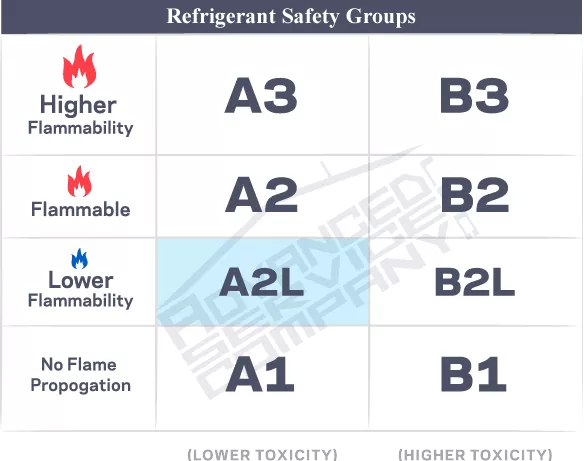
A2L is a classification developed by ASHRAE and is used globally to classify refrigerants based on their toxicity and
flammability. “A” = Low toxicity and “2L” = Mildly flammable (lower flame speed than typical flammable gases). R-410A is
classified as a A1 refrigerant that is low in toxicity and has no flammability, unlike refrigerants like propane that are
highly flammable and classified as A3 refrigerants.
Though mildly flammable, A2L refrigerants are designed to be safe in properly installed systems, and their use is already
widespread globally.